Titration Schedules & Dose-Response Data from Trials
Important: Retatrutide is investigational and not FDA-approved. This dosing information comes from published clinical trials, not prescribing guidelines.
Retatrutide dosing follows once-weekly subcutaneous injections with mandatory slow titration starting at 2 mg, escalating every 4 weeks to maintenance targets of 4-12 mg based on tolerability. Phase 2 trials (NEJM 2023) established dose-dependent weight loss up to 24.2% at 12 mg over 48 weeks, while Phase 3 TRIUMPH data (2025) confirm ~28-29% loss at 68-72 weeks with optimized schedules. This guide details exact trial protocols, responder rates, side effect patterns by dose, and administration specs—not medical advice.
| Dose | Phase 2 (48w) | ≥15% Responders | Phase 3 (68-72w) | Notes |
|---|---|---|---|---|
| 1 mg | 8.7% | ~20% | N/A | Starter only |
| 4 mg | 17.1% | ~50% | ~20% | Low-moderate |
| 8 mg | 22.8% | ~75% | ~26% | Best balance ✓ |
| 12 mg | 24.2% | ~85% | 28-29% | Max efficacy |
| Placebo | 2.1% | <5% | ~3% | Control |
Sources: Jastreboff NEJM 2023; Lilly TRIUMPH Phase 3 topline data (Dec 2025).
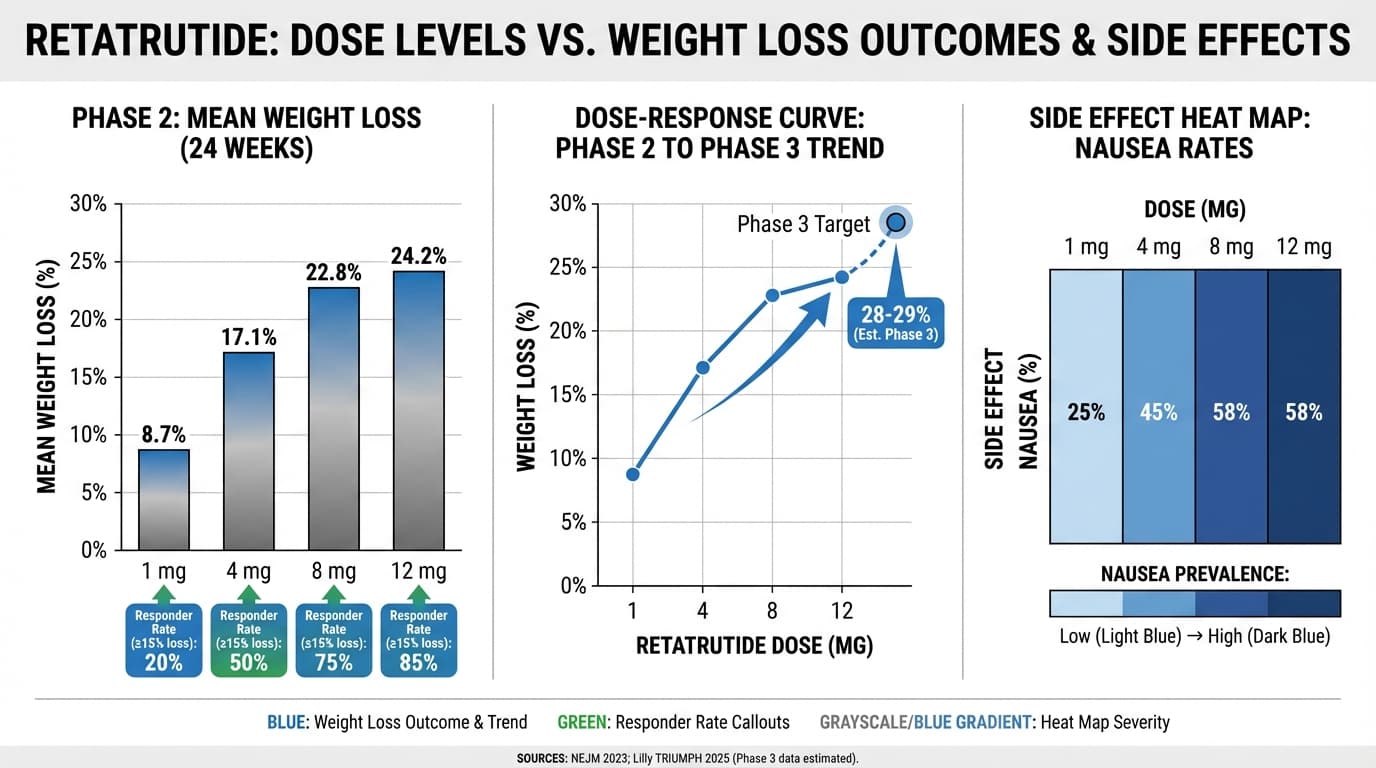
Retatrutide dose-response data from clinical trials
Both Phase 2 and Phase 3 trials used gradual dose escalation to improve tolerability. The schedules below reflect actual trial protocols—Phase 3 standardized on 2 mg starts for better GI outcomes.
Varied starting doses
| Target | W1-4 | W5-8 | W9-12 | W13+ |
|---|---|---|---|---|
| 4 mg | 2 mg | 4 mg | 4 mg | 4 mg |
| 8 mg | 2 mg | 4 mg | 8 mg | 8 mg |
| 12 mg | 2 mg | 4 mg | 8 mg | 12 mg |
Standardized protocol
| Weeks | Dose | Purpose |
|---|---|---|
| 1-4 | 2 mg | Minimize nausea |
| 5-8 | 4 mg | Build tolerance |
| 9-12 | 6-9 mg | Mid-escalation |
| 13+ | 12 mg | Maintenance |
Pause Protocol: Hold 2-4 weeks per step if vomiting occurs >2x/week. With this approach, ~80% of participants reach their target dose. This is NOT a recommended regimen— final FDA-approved dosing may differ.
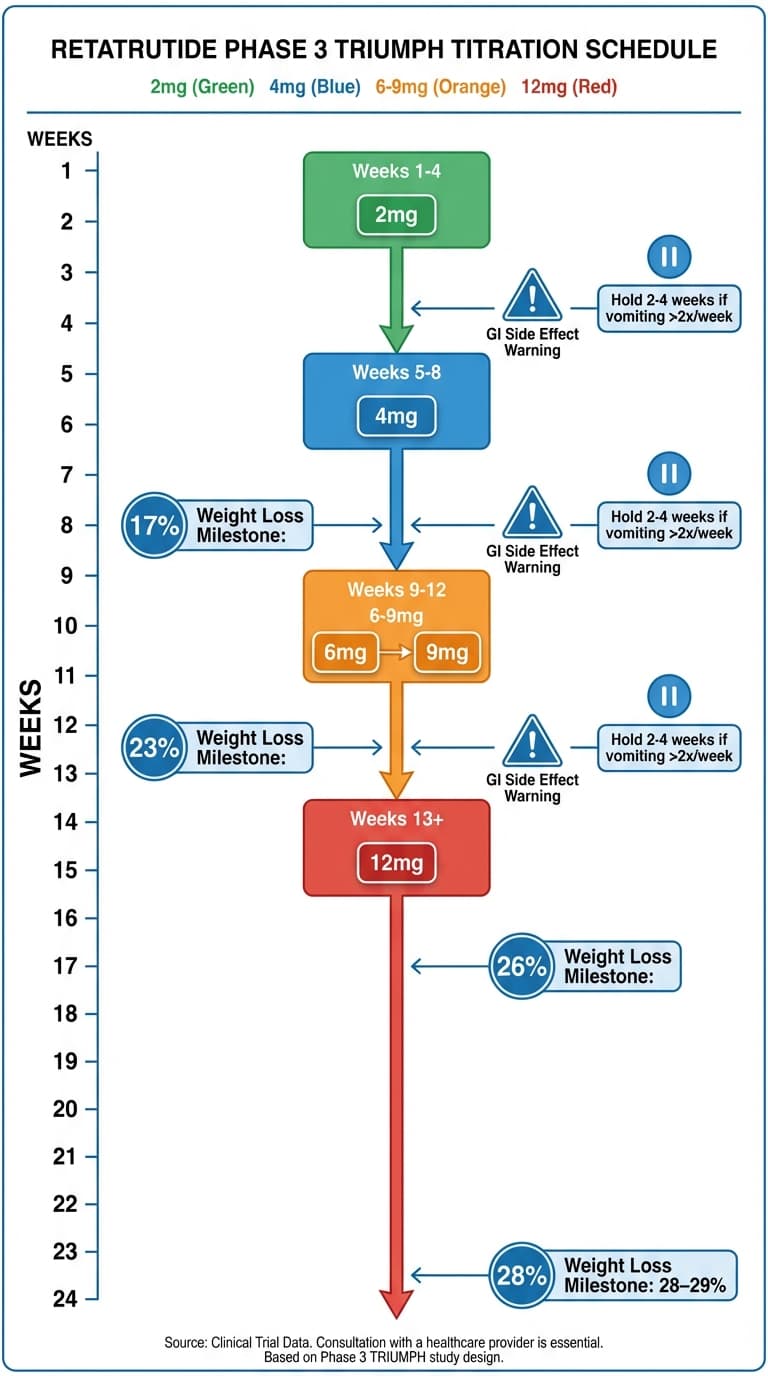
TRIUMPH Phase 3 titration protocol
Based on clinical trial protocols and Lilly's standard GLP-1 delivery systems:
Final commercial formulation may differ. All injection details based on trial protocols and similar Lilly products (tirzepatide).
GI side effects were dose-dependent in clinical trials. Data below from Phase 2 (NEJM 2023) with Phase 3 confirmatory trends:
| Side Effect | 4 mg | 8 mg | 12 mg | Peak / Notes |
|---|---|---|---|---|
| Nausea | 25% | 45% | 58% | Weeks 4-8; resolves |
| Diarrhea | 18% | 28% | 34% | Weeks 2-6 |
| Vomiting | 8% | 15% | 22% | Titration phase |
| Constipation | 10% | 12% | 14% | Less dose-dependent |
| Heart Rate | +2 bpm | +4 bpm | +6 bpm | Mean increase; stable |
| ALT Elevation (>3× ULN) | <1% | 2% | 3-4% | Monitor liver enzymes |
| Discontinuation (AE) | 5% | 10% | 16% | Due to GI mostly |
Post-trial dosing strategies are still being studied, but early signals suggest several patterns for maintaining weight loss long-term:
Long-term maintenance data beyond 72 weeks is limited. FDA approval labeling will include official guidance on maintenance dosing.
2 mg weekly for 4 weeks (all Phase 3 arms). This minimizes GI side effects during the adjustment period.
Every 4 weeks; hold if nausea persists more than 3 days/week. Most patients reach maintenance dose by week 12-16.
8 mg weekly shows 75% responder rate with 10% discontinuation. 12 mg adds ~2% more weight loss but 16% discontinue due to side effects.
Similar 4-week escalation steps, but retatrutide goes to 12 mg max vs tirzepatide 15 mg. Both use once-weekly subcutaneous injections.
Yes; 4 mg gives approximately 17% weight loss long-term with minimal side effects. Some patients maintain on 4 mg after reaching target weight.
31-34G needles in trial pens, with minimal pain reported compared to semaglutide. Commercial formulation may use auto-injector similar to tirzepatide.
No, can be taken anytime regardless of meals. Some patients prefer injecting with a meal if GI-sensitive, but this is personal preference.
Risky and not recommended. Trials used only GMP Lilly product. Compounded peptides lack quality control and may have incorrect dosing or contamination.
Get notified when retatrutide receives FDA approval and becomes available at telehealth providers.
Read the Complete GuideWhile retatrutide remains investigational, these FDA-approved GLP-1 medications are available now through telehealth providers:
| Medication | Targets | Weight Loss | Status |
|---|---|---|---|
| Tirzepatide (Zepbound) | GLP-1 + GIP | ~21% | FDA Approved |
| Semaglutide (Wegovy) | GLP-1 | ~15% | FDA Approved |
| Liraglutide (Saxenda) | GLP-1 | ~8% | FDA Approved |
| Retatrutide | GLP-1 + GIP + Glucagon | ~24-29% | Investigational |
Last reviewed: January 2026. Retatrutide remains investigational (not FDA-approved). Consult a provider.