The Complete Guide to Uses, Benefits, Side Effects & More
Everything you need to know about this GLP-1 medication for Type 2 diabetes and weight management.
Reviewed by AllGLP1 Editorial Team
Liraglutide is a medication used to help control weight and manage type 2 diabetes as a GLP-1 (glucagon-like peptide-1) receptor agonist, a class of drugs that mimic a natural hormone to regulate blood sugar and appetite. It works by activating the body's GLP-1 receptors.
Liraglutide is a man-made GLP-1 hormone. It helps the body release more insulin, lowers glucagon, and slows stomach emptying, resulting in lower blood sugar and increased fullness.
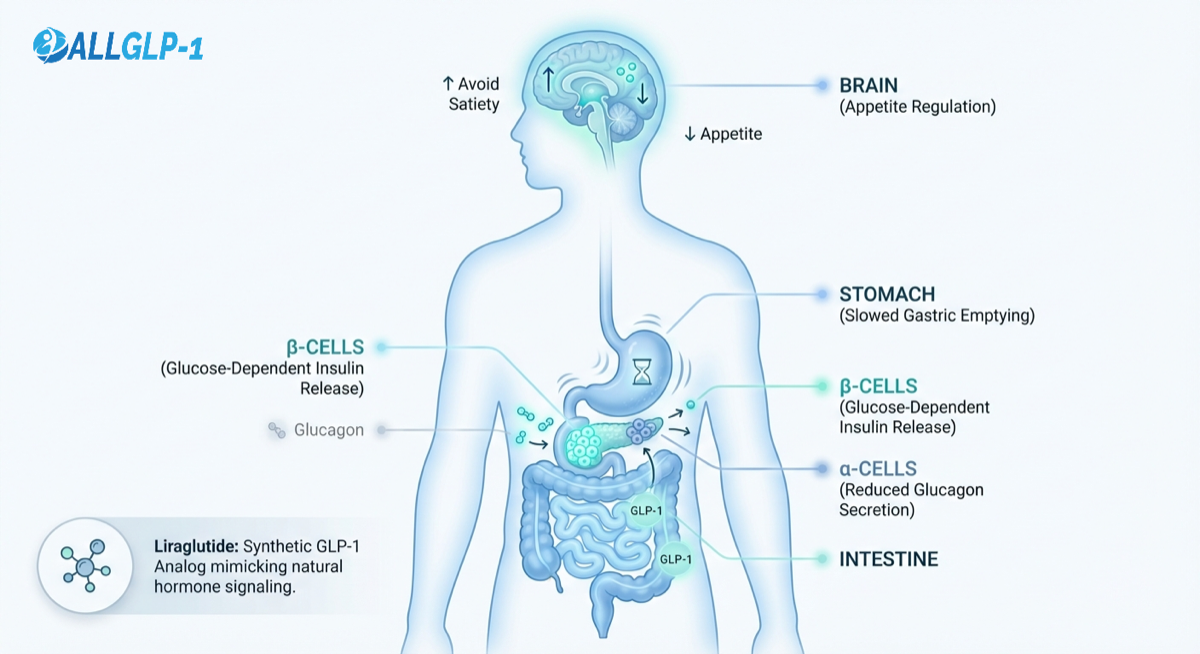
Liraglutide is a GLP-1 receptor agonist that helps control blood sugar and appetite, especially for those with type 2 diabetes who are overweight or obese.
By acting like natural GLP-1, liraglutide improves blood sugar control and reduces appetite to support weight loss.
Saxenda is a brand of liraglutide for weight management in adults with a BMI of 30 or higher, or 27 or higher with conditions such as high blood pressure, type 2 diabetes, or high cholesterol. Saxenda works by controlling appetite and increasing feelings of fullness, supporting weight loss when combined with diet and exercise.
Clinical trials have found users lose about 5-8% of body weight over 56 weeks—roughly 10-16 pounds for someone weighing 200 pounds.
Saxenda helps with weight loss and metabolic health, which may improve quality of life. Many users report increased energy and improved well-being.
Saxenda is given as a subcutaneous injection, usually in the abdomen, thigh, or upper arm. Administered once daily at any time.
Approved for adults with BMI ≥30, or BMI ≥27 with at least one weight-related condition such as hypertension or type 2 diabetes.
The standard starting dose of Saxenda is 0.6 mg daily, increasing by 0.6 mg each week until reaching a maximum of 3.0 mg daily.
| Week | Daily Dose |
|---|---|
| Week 1 | 0.6 mg |
| Week 2 | 1.2 mg |
| Week 3 | 1.8 mg |
| Week 4 | 2.4 mg |
| Week 5+ | 3.0 mg (maintenance) |
Victoza (Liraglutide) manages type 2 diabetes, aids weight loss, and may benefit heart health. The LEADER trial showed it reduces major cardiovascular events in patients with type 2 diabetes, supporting its cardiovascular benefits.
Liraglutide (Victoza) is used to treat type 2 diabetes. It improves how the pancreas works, often leads to weight loss, and rarely causes low blood sugar (hypoglycemia). Most patients tolerate it well; common side effects are digestive problems, such as nausea, which usually peak within two weeks. It is considered a strong option for type 2 diabetes treatment.
— Liraglutide: a review of its use in type 2 diabetes mellitus, 2009
Victoza helps control blood sugar by increasing insulin release after meals and lowering glucagon levels, which can raise blood sugar.
Research shows Victoza reduces the risk of major heart and blood vessel problems in people with type 2 diabetes who have heart disease or are at high risk.
Victoza can be combined with metformin, sulfonylureas, or insulin to help control blood sugar. Consult your doctor to monitor side effects.
Ask your doctor: "How often will my A1c and weight be checked?" to help manage your treatment regimen and ensure proper follow-up.
Since the advent of new policies, canagliflozin, empagliflozin, liraglutide, and semaglutide have shown greater cardiovascular event reduction—via a combined decrease in CV death, nonfatal myocardial infarction, and nonfatal stroke—compared with placebo in patients with type 2 diabetes and existing cardiovascular disease, or at high risk of CVD.
— Antihyperglycemic medications and cardiovascular risk reduction, SL Anderson, 2017
Liraglutide was the first GLP-1 receptor agonist to be specifically approved for chronic weight management. Its safety and efficacy profile was established through two massive global clinical programs: **SCALE** (focused on obesity and pre-diabetes) and **LEADER** (focused on cardiovascular outcomes in diabetes).
New England Journal of Medicine, 2015
This study involved 3,731 participants without Type 2 Diabetes who had a BMI of 30+ or 27+ with weight-related conditions. They were randomized to receive liraglutide 3.0mg or placebo daily for 56 weeks.
Published in 2016, the LEADER trial was a turning point for GLP-1s. It showed that liraglutide significantly reduced the risk of major adverse cardiovascular events (MACE) in high-risk patients.
In a 160-week extension of the SCALE trial, researchers looked at the prevention of Type 2 Diabetes in patients with pre-diabetes.
Liraglutide 3.0mg reduced the risk of developing Type 2 Diabetes by **80%** compared to placebo over 3 years.
With over a decade of real-world use data, liraglutide is one of the most thoroughly understood GLP-1 medications available today.
While newer weekly medications show higher weight loss percentages, liraglutide remains a cornerstone treatment due to its proven safety profile.
The SCALE trials were revolutionary because they proved that obesity could be treated as a biological condition rather than a failure of willpower. By targeting the GLP-1 receptors, liraglutide was able to achieve what traditional dieting often couldn't: a sustained reduction in the body's biological "set point" for weight.
The findings from these trials paved the way for the development of even more potent GLP-1 agonists like semaglutide and tirzepatide, but liraglutide continues to be a vital option—especially for patients who prefer its shorter half-life or those whose insurance specifically covers Saxenda.
Unlike newer GLP-1 medications that are injected once weekly, liraglutide (Saxenda and Victoza) is a daily injection. While this requires more frequent administration, it offers a unique advantage: **the ability to fine-tune your dosing schedule** based on your body's specific rhythm and side effect profile.
Best for those who experience the strongest "food noise" or hunger in the late afternoon and evening.
Preferred by patients who experience mild nausea or fatigue shortly after injection.
Ideal for individuals with irregular schedules or those who find they need coverage specifically for dinner.
Liraglutide has a half-life of 13 hours. To maintain steady levels in your bloodstream, try to inject within the same 2-hour window every day.
Since you are injecting daily, site rotation is critical. Use a "clock pattern" around your belly button to prevent lipohypertrophy (lumps under the skin).
Drink 16oz of water with electrolytes within 30 minutes of your injection. This helps your kidneys process the medication and reduces nausea.
Saxenda/Victoza pens can stay at room temperature (up to 86°F) for 30 days once in use. Perfect for daily carry without needing ice packs.
If you miss a dose, take it as soon as you remember—provided there are at least **12 hours** until your next scheduled dose. If there are less than 12 hours, skip the missed dose and resume your normal schedule the following day. **Never take a double dose** to make up for a missed one.
*Always consult your healthcare provider before changing your injection timing or dose escalation schedule.
Liraglutide was one of the first medications to demonstrate that long-term weight maintenance is possible through pharmacological support. As a daily medication, maintenance strategies often involve tapering the dose or focusing on the transition to lifestyle-only management for those who choose it.
Because liraglutide is injected daily, patients have more control over their tapering process. Doctors may recommend reducing the dose by 0.6mg increments every few weeks to find a "minimal effective dose" for maintenance.
In the SCALE Maintenance trial, individuals who achieved a 5% or greater weight loss through a low-calorie diet and then started liraglutide were able to maintain that loss significantly better than those on placebo.
"Liraglutide provides the biological support needed to prevent the body's natural starvation response from driving weight back up."
Even at maintenance doses, liraglutide continues to offer cardiovascular benefits, particularly for those with pre-existing heart conditions or high risk factors.
For patients who started liraglutide with pre-diabetes, maintenance is often focused on preventing the progression to Type 2 Diabetes, a goal achieved by 80% of SCALE trial participants.
Liraglutide's shorter half-life makes it an excellent "training wheels" medication for long-term metabolic health. While some move on to weekly injections, many find the daily routine of liraglutide to be the best way to maintain their results.
Liraglutide is well-tolerated, but patients should be aware of potential side effects and management strategies before starting. Most side effects are manageable and tend to improve over time as your body adjusts to the medication.
Seek immediate medical attention for severe symptoms.
For severe symptoms such as stomach pain, yellowing of the skin or eyes, or signs of pancreatitis, seek medical help immediately. Watch for any unusual symptoms and tell your doctor right away if they occur.
Liraglutide is one of several GLP-1 receptor agonists used to treat diabetes and aid weight loss. This section explains how it compares with other medications in the same class, helping patients make informed choices.
| Aspect | Liraglutide | Semaglutide | Tirzepatide |
|---|---|---|---|
| Administration | Daily injection | Weekly injection | Weekly injection |
| Weight Loss Efficacy | Moderate (5-8%) | High (~15%) | Very High (~20%) |
| Diabetes Control | Effective | Highly effective | Highly effective |
| Mechanism | GLP-1 only | GLP-1 only | GLP-1 + GIP dual |
| Side Effects | Nausea, vomiting, diarrhea, constipation | Nausea, vomiting, diarrhea | Nausea, vomiting, diarrhea |
| Safety Record | Longest (since 2010) | Established (since 2017) | Newer (since 2022) |
Semaglutide, another GLP-1 agonist, may promote greater weight loss than liraglutide. Liraglutide is administered daily, while semaglutide is given weekly. The choice may depend on patient preferences, such as convenience or a longer safety record. Match the medication to individual values for a tailored decision.
Tirzepatide acts on both GLP-1 and GIP (glucose-dependent insulinotropic polypeptide) receptors, which are cell-surface proteins that support weight loss and blood sugar control. This dual mechanism may provide enhanced efficacy for diabetes and weight management compared to GLP-1-only medications like liraglutide.
Long-term use, cost, and access are important factors for patients to consider before starting liraglutide treatment. Understanding your options can help you plan for sustainable treatment.
Insurance coverage for Liraglutide varies. Patients should confirm coverage with their insurer. Some plans cover Victoza for diabetes but not Saxenda for weight loss.
Patient assistance programs may help eligible people lower costs. Novo Nordisk offers savings programs for both Saxenda and Victoza for qualifying patients.
Long-term Liraglutide use helps maintain weight loss and blood sugar control. Consistent use provides the best outcomes for metabolic health.
Stopping liraglutide can cause weight and blood sugar to rise. Discuss long-term plans with your provider to get the support you need.
By understanding liraglutide's mechanism of action and its proven benefits, patients can make informed choices for their health. Possible next steps include speaking with a healthcare provider or reviewing your insurance coverage—whichever helps you get started on your journey.
Daily injection vs weekly — efficacy and cost compared.
What to expect from daily GLP-1 dosing.
The lowest verified monthly prices across all medications.
Live GLP-1 prices across ~100 providers, verified daily.
Protein-first meals built for suppressed appetite.